
Eighties Archive Song Number
Highest Chart Position
Date Released
Date Of UK Top 40 Entry
Genre
Label
Catalogue Number
Story Behind The Song
Released in 1985, “West End Girls” became the breakthrough single that established Pet Shop Boys as one of Britain’s most innovative pop acts. Featured on their debut album, Please, the song introduced the songwriting partnership of Neil Tennant and Chris Lowe to a mainstream audience, combining sophisticated electronic production with intelligent, observational lyrics. Its atmospheric sound and understated style set it apart from the more conventional pop records of the era.
Written by Tennant and Lowe, the song paints a vivid picture of life in London’s West End and East End, exploring themes of class, ambition, urban tension and social division. Inspired in part by T. S. Eliot’s poem The Waste Land, the lyrics mix everyday observations with poetic imagery, creating a song that rewards repeated listening. Neil Tennant’s conversational vocal delivery, combined with Chris Lowe’s moody synthesiser arrangements and hypnotic rhythm, gives the track its distinctive and timeless character.
The success of “West End Girls” launched Pet Shop Boys into the forefront of British pop and marked the beginning of one of the most successful careers in electronic music. It remains the duo’s defining recording and a landmark in synth-pop history. Today, the song is celebrated for its intelligent songwriting, innovative production and effortlessly cool atmosphere, standing as one of the most influential and enduring British pop singles of the 1980s.
The song peaked at No. 01 on the UK Singles Charts on the 11th January 1986.
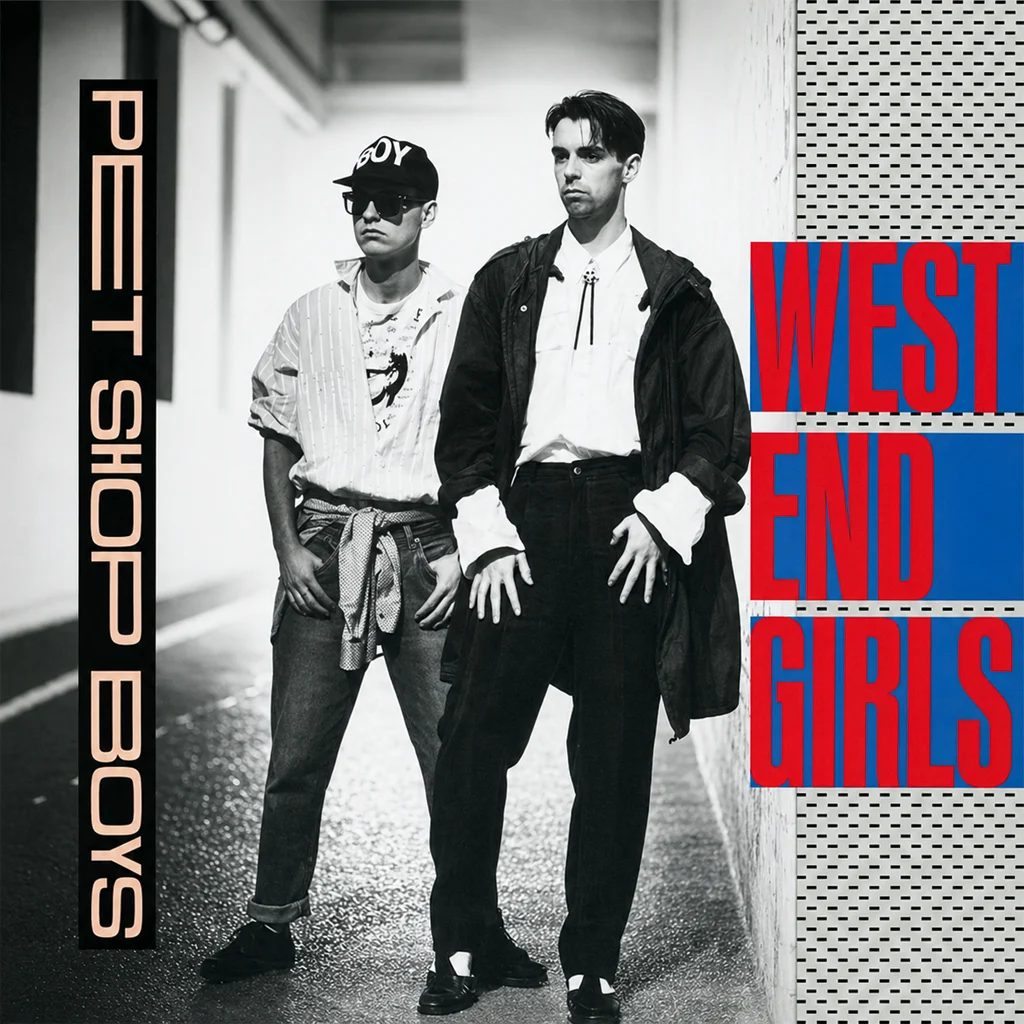
UK 7'' SLEEVE COVERS
Shown below are the picture sleeve covers (front and back) for the UK release of this single. If no cover sleeve was issued in the UK, we will display another country’s picture sleeve.

UK 7'' TRACK LISTING
| A-Side | West End Girls (4:00) (Neil Tennant, Chris Lowe) Produced By Stephen Hague |
| B-Side | A Man Could Get Arrested (4:50) (Neil Tennant, Chris Lowe) Produced By Stephen Spiro |
CHART PERFORMANCE (80s Chart only)
| UK Top 40 Chart Run [12 Weeks] – 30th November 1985 – 15th February 1986 |
OFFICIALLY RELEASED VERSIONS
All officially released versions that appeared in the 80s:-
- West End Girls (Single Version) (4:00)
- West End Girls (Dance Mix) (6:39)
- West End Girls (10” Mix) (7:00)
- West End Girls (Shep Pettibone Mastermix) (8:10)
- West End Girls (Dub Version) (9:33)
- West End Girls (Disco Album Mix) (9:03)
- West End Girls (Album Version) (4:46)
To hear the FULL version of the songs below, you will need an active Spotify account (Free one). Just log in on your desktop/tablet or phone to hear the FULL versions.
OFFICIAL VIDEO
SONG LYRICS
Sometimes you’re better off dead
There’s gun in your hand and it’s pointing at your head
You think you’re mad, too unstable
Kicking in chairs and knocking down tables
In a restaurant in a West End town
Call the police, there’s a madman around
Running down underground to a dive bar
In a West End town
In a West End town, a dead end world
The East End boys and West End girls
In a West End town, a dead end world
The East End boys and West End girls
West End girls
Too many shadows, whispering voices
Faces on posters, too many choices
If, when, why, what?
How much have you got?
Have you got it, do you get it, if so, how often?
And which do you choose, a hard or soft option?
(How much do you need?)
In a West End town, a dead end world
The East End boys and West End girls
In a West End town, a dead end world
The East End boys and West End girls
West End girls
West End girls
(How much do you need?)
In a West End town, a dead end world
The East End boys and West End girls
Oooh West End town, a dead end world
East End boys, West End Girls
West End girls
You’ve got a heart of glass or a heart of stone
Just you wait ’til I get you home
We’ve got no future, we’ve got no past
Here today, built to last
In every city, in every nation
From Lake Geneva to the Finland station
(How far have you been?)
In a West End town, a dead end world
The East End boys and West End girls
A West End town, a dead end world
East End Boys, West End girls
West End girls
West End girls
West End girls
(How far have you been?)
Girls
East End boys
And West End girls
And West End girls
(… forever)
And West End girls
(How far have you been?)
East End boys
The West End girls
The West End boys
And West End girls
The West End girls
The West End boys
The West End girls
Written By Neil Tennant, Chris Lowe
1 Comment
Hello All
Have we made any mistakes in this posting? Feel free to let us know (we’d appreciate it!)
Regards
Admin