

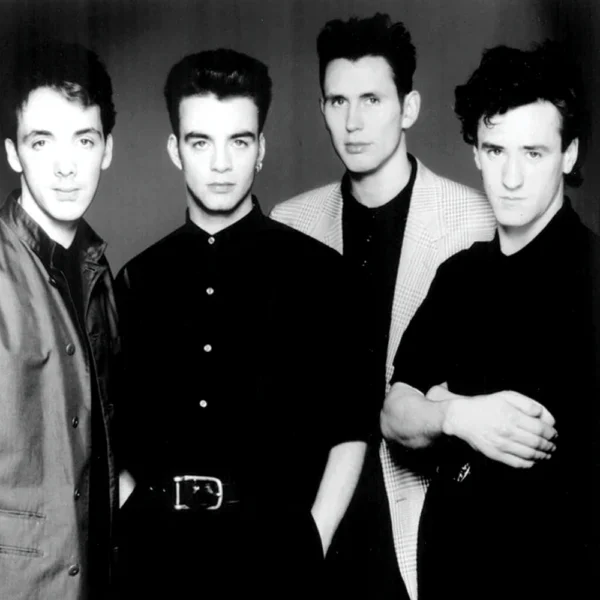
The release of Hipsway’s self-titled debut album in 1986 marked a pivotal moment for the Glasgow music scene, offering a sleek, cosmopolitan alternative to the more earnest guitar pop of the era. From the opening notes, it was clear that the band—comprising vocalist Grahame Skinner, guitarist Pim Jones, bassist Johnny McElhone, and drummer Harry Travers—was aiming for a sound that could travel far beyond the rain-slicked streets of Scotland. The album was a sophisticated blend of white-soul sensibilities, funk-inflected rhythms, and the kind of high-gloss production that defined the mid-80s, managing to feel both commercially ambitious and artistically distinctive.
The record is dominated by the magnetic presence of Grahame Skinner, whose deep, resonant baritone provided a brooding weight to the band’s rhythmic agility. His voice acted as a tether, ensuring that even the most danceable tracks retained a sense of mystery and late-night atmosphere. This is best exemplified by the album’s centerpiece and breakout hit, “The Honeythief.” With its jagged, infectious guitar hook and driving bassline, the song became a global success, perfectly capturing the band’s ability to fuse pop accessibility with a slightly predatory, enigmatic edge. It wasn’t just a catchy tune; it was a masterclass in space and timing, utilizing a minimalist funk structure that allowed every element to breathe.
Beyond the singles, the album is remarkably consistent, exploring various shades of blue-eyed soul and sophisticated rock. Tracks like “Ask the Lord” and “The Broken Years” showcased Pim Jones’s versatile guitar work, which often eschewed traditional power chords in favour of rhythmic stabs and shimmering textures. Johnny McElhone’s bass playing, meanwhile, provided the melodic backbone of the record, a skill he would later take to even greater heights with Texas. There is a cinematic quality to the songwriting throughout, with lyrics that often hinted at urban isolation, desire, and the complexities of modern romance, all delivered with Skinner’s signature detached cool.
The production, handled largely by Gary Langan—a co-founder of the Art of Noise—gave the album a sonic depth that helped it compete on an international level. The drums were crisp and cavernous, the synths were used with tasteful restraint, and the overall mix had a clarity that still sounds remarkably fresh today. This professional sheen did not strip the band of their character; instead, it elevated their local Glasgow roots into something that felt universal. Even on slower, more atmospheric tracks like “Upon a Golden Horse,” the band maintained a tight, disciplined tension that kept the listener engaged.
Ultimately, Hipsway remains a quintessential 1980s document, yet it avoids the dated clichés that plague many of its contemporaries. It represents a brief, brilliant window where all the creative elements aligned perfectly for the group. Although the departure of McElhone shortly after its release and the long gap before their second album hindered their momentum, this debut stands as a towering achievement in Scottish pop history. It is an album that captures the glamour and the grit of its time, serving as a reminder of a period when Glasgow was the epicenter of a very specific, very stylish kind of musical revolution.
The album peaked at No. 42 in the UK album charts on 10th May 1986.
Hipsway
Hipsway
Release Date
11th April 1986
Highest Chart Position
No. 42 (10th May 1986)
Genre
Electronic, Pop, New Wave
Tracklisting
The Honeythief
Ask The Lord
Bad Thing Longing
Upon A Thread
Long White Car
The Broken Years
Tinder
Forbidden
Set The Day Apart
You can listen to the album below on Spotify. If you have a paid Spotify account, log in, to listen to all tracks (complete). If you do not have a paid Spotify account, you can only listen to a 30-second sample of each track.