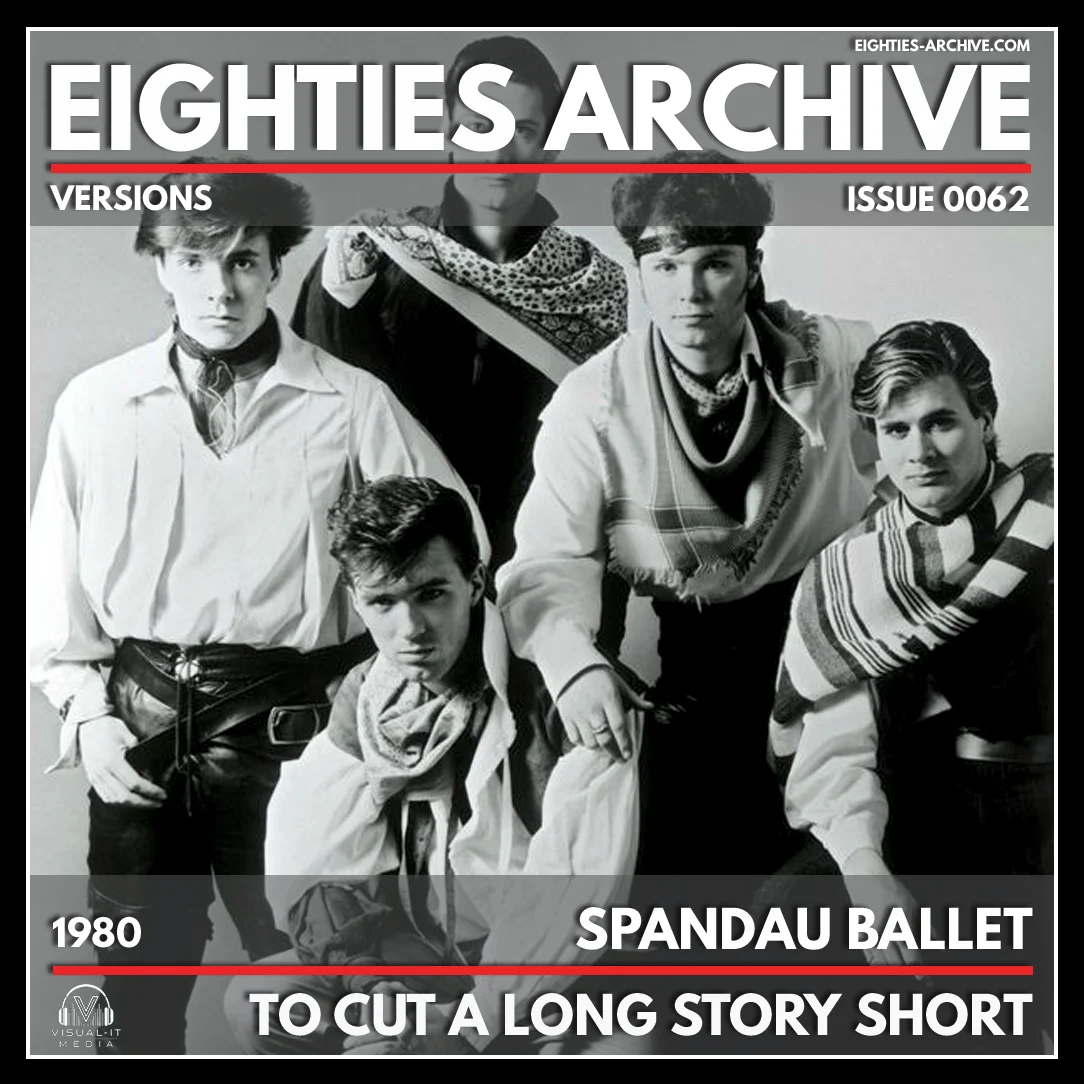
Released in late 1980 as their explosive debut single, Spandau Ballet’s “To Cut a Long Story Short” stands as a foundational monument of the New Romantic movement and a masterclass in early synth-pop innovation. Emerging from the stylish, underground crucible of the Blitz club in London, the track served as a sonic manifest for a subculture obsessed with fashion, futurism, and European romanticism. Clocking in at just over three minutes, it announced the arrival of a band that would help define the aesthetic of a decade, capturing the stark, transitional energy of a Britain moving away from the raw fury of punk and into a sleek, electronic future.
At its core, “To Cut a Long Story Short” is an exercise in psychological tension and atmospheric dread. Written by the band’s primary songwriter and guitarist, Gary Kemp, the lyrics are famously abstract, fragmented, and open to interpretation. Rather than delivering a conventional narrative, the verses offer a series of vivid, disorienting images that hint at alienation, trauma, and the claustrophobia of the human mind. The repetitive refrain of the title functions as a desperate attempt to summarize an overwhelming emotional experience that defies easy explanation. Gary Kemp later revealed that the song’s military metaphors and themes of mental strain were partly inspired by the haunting, lingering effects of shell shock and the psychological aftermath of war, a subject matter that lent the track a profound, historical weight beneath its danceable surface.
What elevates the song from a standard club track into a piece of enduring art is its brilliant use of cutting-edge technology to mirror this internal psychological chaos. The track is built around a relentless, hypnotic sequencer line programmed on a Yamaha CS-80 synthesizer. This driving electronic pulse creates a cold, mechanical momentum that feels both futuristic and menacing, perfectly capturing the dystopian anxieties of the early 1980s. Against this rigid electronic framework, John Keeble’s acoustic drumming adds a fierce, muscular urgency, driving the rhythm forward with the precision of a military march. This juxtaposition of the synthetic and the human created a dark, compelling danceability that became the hallmark of the Blitz club scene.
Tony Hadley’s vocal performance on the track is nothing short of revelatory, establishing him immediately as one of the definitive voices of his generation. Rejecting the snarling detachment of punk and the understated delivery of traditional synth bands, Hadley adopted a dramatic, operatic baritone that soared over the electronic arrangement. His voice bounces gracefully from low, brooding verses to a powerful, theatrical vibrato in the chorus, investing the abstract lyrics with a genuine sense of urgency and emotional stakes. He does not merely sing the words; he delivers them like a Shakespearean soliloquy set to a disco beat, transforming a minimalist pop song into a widescreen electronic drama.
The arrangement is further enriched by the intricate interplay between Gary Kemp’s sharp, biting guitar licks and his brother Martin Kemp’s pulsating, melodic bassline. Steve Norman, who would later become famous for his saxophone contributions, provides additional percussion that injects a subtle, polyrhythmic complexity into the track. The studio production by Richard James Burgess, who famously coined the term “synth-pop” during this era, is a masterclass in sonic clarity and spatial awareness. Every synth staccato, drum strike, and vocal layer is given room to breathe, creating a stark, icy, and immaculate soundscape that felt completely alien and thrilling to listeners in 1980.
Decades after its release, “To Cut a Long Story Short” remains a towering achievement because it captures the precise moment a new subculture broke into the mainstream consciousness. It peaked at number five on the UK Singles Chart, proving that the avant-garde, fashionable elite of London’s nightlife could create music that was both uncompromisingly experimental and massively commercial. While Spandau Ballet would later transition into a smoother, blue-eyed soul and sophisticated pop sound with global hits like “True” and “Gold,” this debut single captures them at their most raw, inventive, and daring.
The track stands as a timeless reminder of a period when the synthesizer was not just an instrument, but a weapon of cultural revolution. It invites the listener to step onto a smoke-filled dancefloor in 1980, where fashion, art, and technology collided to reshape the musical landscape forever.
The song peaked at No. 05 in the UK Singles Chart on 6th December 1980.
Lyrics
Soldier is turning
See him through white light
Running from strangers
See you in the valley
War upon war
Heat upon heat
To cut a long story short
I lost my mind
Sitting on a park bench
Years away from fighting
To cut a long story short
I lost my mind
Standing in the dark
Oh I was waiting for man to come
I am beautiful and clean
And so very very young
To be standing in the street
To be taken by someone
Questions questions
Give me no answers
That’s all they ever give me
Questions questions
Oh look at the strange boy
He finds it hard existing
To cut a long story short
I lost my mind
To cut a long story short
I lost my…
Mi-i-i-i-ind!
Written by Gary Kemp